
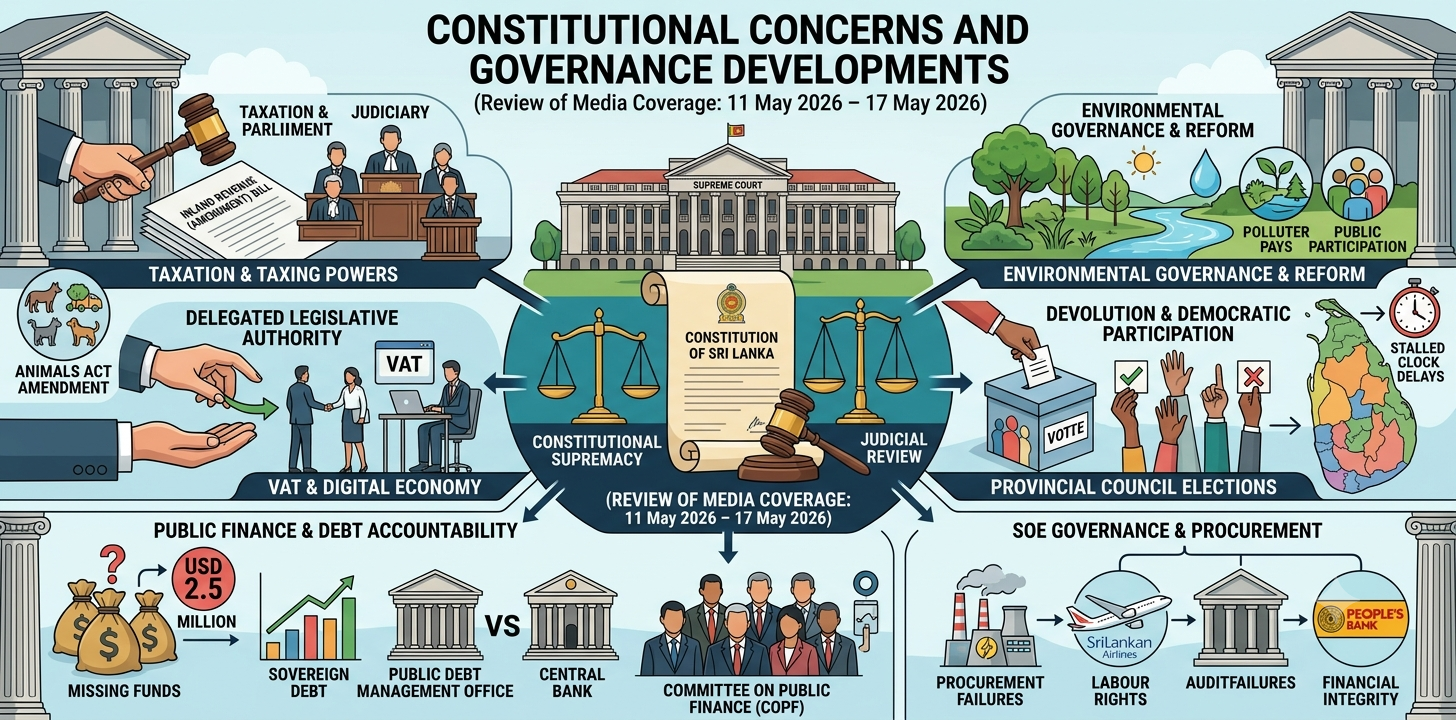
Constitutional Concerns and Governance Developments
(Review of Media Coverage: 11 May 2026 – 17 May 2026)
This week’s media coverage highlights developments that raise significant constitutional questions relating to judicial review of taxation laws, environmental governance, delegated fiscal powers, public finance accountability, devolution, State-Owned Enterprise (SOE) governance, procurement oversight, regulatory transparency, and institutional safeguards in public administration.
Judicial Review, Taxation Powers and the Inland Revenue (Amendment) Bill
The Supreme Court recently determined that Section 31(4) of the Inland Revenue (Amendment) Bill is inconsistent with the Constitution and therefore requires approval by a special majority in Parliament.
Constitutionally, these developments engage principles relating to judicial review of legislation, constitutional supremacy, legality in taxation, due process, and the protection of individuals against disproportionate State sanctions. The determination reinforces the constitutional role of the judiciary as an institutional safeguard against legislative overreach, particularly in areas involving taxation and coercive State powers. The ruling highlights the importance of ensuring that taxation laws comply with constitutional standards of legality, fairness, and proportionality.
Environmental Governance and Reform of the National Environmental Act
The Government announced significant reforms to the National Environmental Act, including the introduction of the “polluter pays” principle through load-based environmental charges, the classification of major pollution offences as cognisable offences permitting arrest without warrant, mandatory environmental clearances for development projects, and strengthened enforcement powers for the Central Environmental Authority in collaboration with law enforcement agencies.
Constitutionally, this engages principles relating to environmental protection, sustainable development, public participation in environmental governance, administrative accountability, due process, and personal liberty. The reforms contribute to growing constitutional discourse concerning the recognition of environmental rights as enforceable legal rights rather than merely aspirational policy objectives.
Delegated Taxation Powers and Taxation of the Digital Economy
Recent changes to the Value Added Tax (VAT) regime introduced taxation of services supplied through electronic platforms, revised mandatory registration thresholds requiring registration when supplies exceed Rs. 9 million within a tax period, and increased the Financial Services Value Added Tax (FSVAT) rate from 18% to 20.5%.
Constitutionally, the issue engages principles relating to parliamentary control over taxation, delegated legislative authority, legal certainty, administrative fairness, and accountability in fiscal governance. The reforms highlight emerging constitutional challenges associated with regulating and taxing the digital economy. Effective implementation requires transparent legal frameworks capable of ensuring predictability, accessibility, and fairness for taxpayers operating across national jurisdictions.
Legislative Reform and the Animals Act Amendment
Cabinet approval was granted for amendments to the Animals Act, expanding the statutory definition of “animal” to include pigs, goats, and sheep. The Attorney General has reportedly cleared the proposed amendments, which are expected to be gazetted and subsequently presented to Parliament.
Constitutionally, this engages principles relating to legislative procedure, pre-legislative scrutiny, transparency in law-making, and public participation in governance. This development contributes to broader constitutional discussions regarding animal welfare, environmental stewardship, and the role of directive principles in shaping public policy.
Provincial Council Elections and the Democratic Deficit in Devolution
While Government representatives reiterated their intention to hold Provincial Council elections during the year, opposition parties criticised continuing delays and questioned the effectiveness of ongoing parliamentary processes relating to electoral reforms and delimitation.
Constitutionally, this engages principles relating to devolution of power, democratic participation, periodic elections, representative governance, and provincial autonomy. The continued postponement of Provincial Council elections raises serious constitutional concerns regarding the sustainability and legitimacy of Sri Lanka’s devolution framework.
Public Finance Accountability and Debt Governance
Public attention remained focused on the unresolved disappearance of approximately USD 2.5 million linked to sovereign debt servicing, with reports indicating that multiple debt instalments were unpaid despite government claims of payment. Investigations reportedly pointed to a Delaware-based company allegedly used to conceal cyber-related activities connected to the case. Concerns were also raised about the transfer of debt management from the Central Bank to the Public Debt Management Office (PDMO), particularly regarding institutional capacity and staffing. Additionally, parliamentary controversy persisted as officials from the Ministry of Finance repeatedly failed to appear before the Committee on Public Finance (COPF) to address major financial issues.
Constitutionally, these developments engage principles relating to parliamentary sovereignty over public finance, ministerial accountability, transparency in debt management, legislative oversight, and institutional competence in fiscal administration.
State-Owned Enterprise Governance, Procurement Oversight, and Labour Rights
Concerns continued regarding restructuring within the electricity sector, including delays in payment of employee entitlements and concerns regarding transparency and implementation of voluntary retirement schemes valued at approximately Rs. 8.5 billion. Allegations regarding coal imports for the Lakvijaya Power Plant continued, with concerns raised regarding procurement failures, operational losses, and non-cooperation with investigative processes.
Constitutionally, these developments engage principles relating to labour rights, transparency in public administration, procurement integrity, accountability in SOE governance, and legislative oversight.
Regulatory Governance and Economic Management through Delegated Instruments
The Government reintroduced a 50% surcharge on customs duties applicable to imported vehicles for a period of three months, while providing exemptions for letters of credit opened on or before 15 May. The measure formed part of broader efforts to manage economic pressures and foreign exchange concerns.
Constitutionally, this issue engages principles relating to delegated legislation, parliamentary oversight, fiscal governance, transparency in economic regulation, and executive accountability. The controversy reinforces the constitutional importance of ensuring that major fiscal measures remain subject to effective legislative oversight, impact assessment requirements, and clearly defined legal limits.
Financial Control Failures and Public Sector Accountability
Concerns regarding financial controls emerged following disclosures by SriLankan Airlines relating to two separate fraud incidents involving fraudulent payments and internal misappropriation of funds. Reports also revealed that a foreign exchange rate system error within People’s Bank resulted in customer overpayments amounting to approximately Rs. 656 million over several years.
Constitutionally, these developments engage principles relating to accountability in public institutions, audit governance, transparency, financial integrity, and oversight of State-owned enterprises.
Medical Education Governance and Independent Policy Development
The Government appointed a 15-member expert committee to formulate a national policy framework aimed at aligning medical education with the needs of the national healthcare system. The initiative seeks to improve long-term planning, professional standards, and workforce development within the health sector.
Constitutionally, this engages principles relating to education, public health governance, evidence-based policymaking, and institutional independence.



Comments (0)
Sign in to leave a comment
No comments yet. Be the first to comment!