
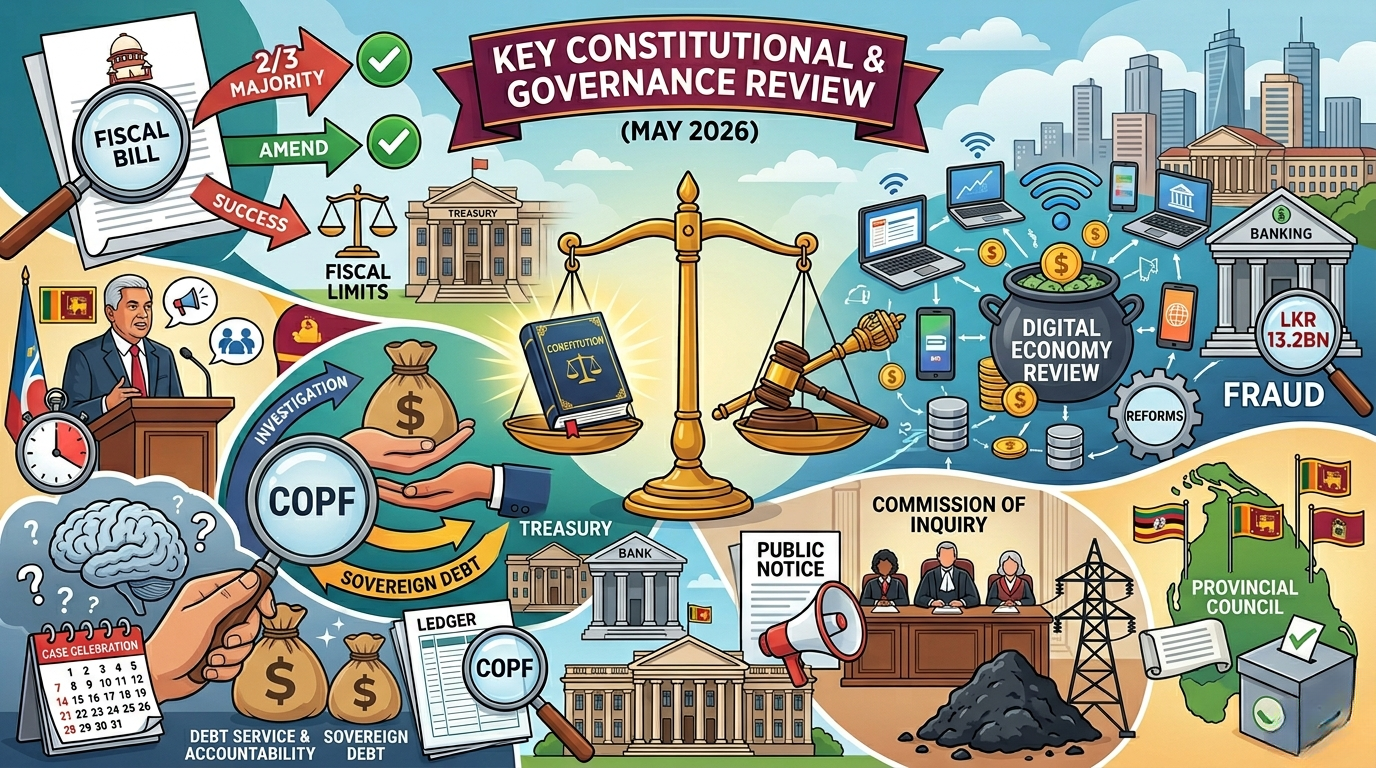
Key Constitutional and Governance Developments
(Review of Media Coverage: 4 May 2026 – 10 May 2026)
This week’s media coverage highlights developments from the week which raise significant constitutional questions relating to judicial review of legislation, judicial independence, parliamentary control over public finance, accountability in public financial management, commissions of inquiry, devolution, taxation of the digital economy, and governance concerns surrounding State-Owned Enterprise (SOE) restructuring.
Judicial Review of Legislation and Constitutional Limits on Fiscal Powers
The Supreme Court determined that Clause 31(4) of the Inland Revenue (Amendment) Bill was inconsistent with the Constitution and would require approval by a two-thirds majority in Parliament if enacted without amendment. The Court further held that the remaining provisions of the Bill could be passed by a simple majority. Petitions relating to Clauses 4, 9, and 28 were permitted to be withdrawn following their removal from the proposed legislation.
Constitutionally, this issue involves principles relating to judicial review of legislation, constitutional supremacy, parliamentary legislative procedure, and limitations on executive and legislative authority in fiscal governance.
Judicial Independence and Public Commentary on Pending Court Proceedings
During the May Day rally of the National People’s Power (NPP), the President remarked that the judgment in a case heard on 30 April wouldl be delivered on 25 May and that supporters should prepare to celebrate the outcome. The remarks generated concerns of indirect political pressure upon the judiciary. However, the Minister of Justice publicly assured that there would be no governmental interference in the judicial process.
Constitutionally, this issue engages principles concerning judicial independence, separation of powers, fair trial guarantees, public confidence in the administration of justice, and limitations on executive influence over the judiciary. The issue reinforces the constitutional importance of preserving clear institutional boundaries between the executive and the judiciary.
Parliamentary Oversight, Public Financial Management, and Institutional Accountability
The Committee on Public Finance (COPF) highlighted inconsistencies among institutions and officials in the disappearance of approximately USD 2.5 million connected to the sovereign debt servicing payments. Treasury officials also repeatedly failed to attend COPF proceedings.
While approximately USD 625,000 collected by the Postal Department for transactions involving the United States Postal Service (USPS) had not been received by the relevant institution, court proceedings directed the Sri Lanka Computer Emergency Readiness Team (CERT) to investigate the matter. The United States had also expressed willingness to support the investigative efforts.
Reports also suggest that approximately LKR 500 million in duplicate or excess payments had allegedly been disbursed under the Aswesuma social assistance programme.
The Committee on Public Finance additionally questioned the Central Bank’s supervisory role in relation to alleged large-scale internal fraud within the National Development Bank (NDB), reportedly amounting to approximately LKR 13.2 billion.
Moreover, allegations connected to Sri Lanka Insurance Corporation investments in Treasury bonds, including concerns relating to pricing, approvals, and financial losses were rejected publicly.
Constitutionally, these issues engage principles relating to parliamentary control over public finance, ministerial accountability, legislative oversight, transparency in fiscal governance, institutional integrity, and accountability within public financial management systems. The developments collectively underscore persistent structural weaknesses within Sri Lanka’s systems of financial oversight, audit governance, and institutional accountability. These incidents additionally reinforce broader constitutional discussions regarding the need for stronger enforcement powers for parliamentary oversight committees, enhanced public financial management standards, and clearer accountability structures governing sovereign debt management and major public financial transactions.
Presidential Commissions of Inquiry and Accountability Mechanisms in Governance
A Special Presidential Commission appointed to examine alleged irregularities relating to coal imports and the electricity sector formally commenced operations during the week. Public notices invited individuals to submit complaints, evidence, and relevant information to assist the inquiry process before 22 May.
Constitutionally, this issue engages principles relating to executive investigative powers, public accountability, transparency in procurement, oversight of public administration, and institutional responses to allegations of corruption and maladministration. The developments reinforce the constitutional importance of ensuring that commissions operate independently, transparently, and within clearly defined procedural safeguards. Public confidence in such inquiries depends upon perceptions of impartiality, fairness, and effective follow-up action.
Devolution, Provincial Councils, and the Democratic Vacuum
Public discussion regarding the prolonged delay in Provincial Council elections continued during the week, with commentators highlighting the political, democratic, and economic consequences of the absence of functioning provincial administrations. Despite concerns regarding the democratic legitimacy of provincial governance structures, public discourse surrounding Provincial Council elections had diminished amid growing national political attention directed toward other electoral developments.
Constitutionally, this issue engages with principles relating to devolution of power, democratic representation, periodic elections, provincial autonomy, and constitutional obligations relating to sub-national governance.
Taxation of the Digital Economy and Fiscal Governance
The new Value Added Tax (VAT) measures applicable to digital and electronic services, scheduled to take effect from 1 July, extend VAT obligations to electronic platforms and digital service providers operating within Sri Lanka. The reforms additionally increase the Financial Services Value Added Tax (FSVAT) rate from 18% to 20.5%, while introducing revised registration thresholds requiring mandatory registration for entities exceeding LKR 9 million within a specified tax period.
Constitutionally, this issue engages principles relating to taxation powers, delegated legislation, administrative fairness, due process protections for taxpayers, and economic governance within an increasingly digital economy. The expansion of VAT into digital and cross-border electronic transactions highlights emerging constitutional challenges concerning the regulation and taxation of the digital economy. Effective implementation of such measures requires adequate institutional capacity, transparency in delegated rule-making, and clear protections for taxpayer rights.



Comments (0)
Sign in to leave a comment
No comments yet. Be the first to comment!