
(Review of Media Coverage: 12 January 2026 – 18 January 2026)
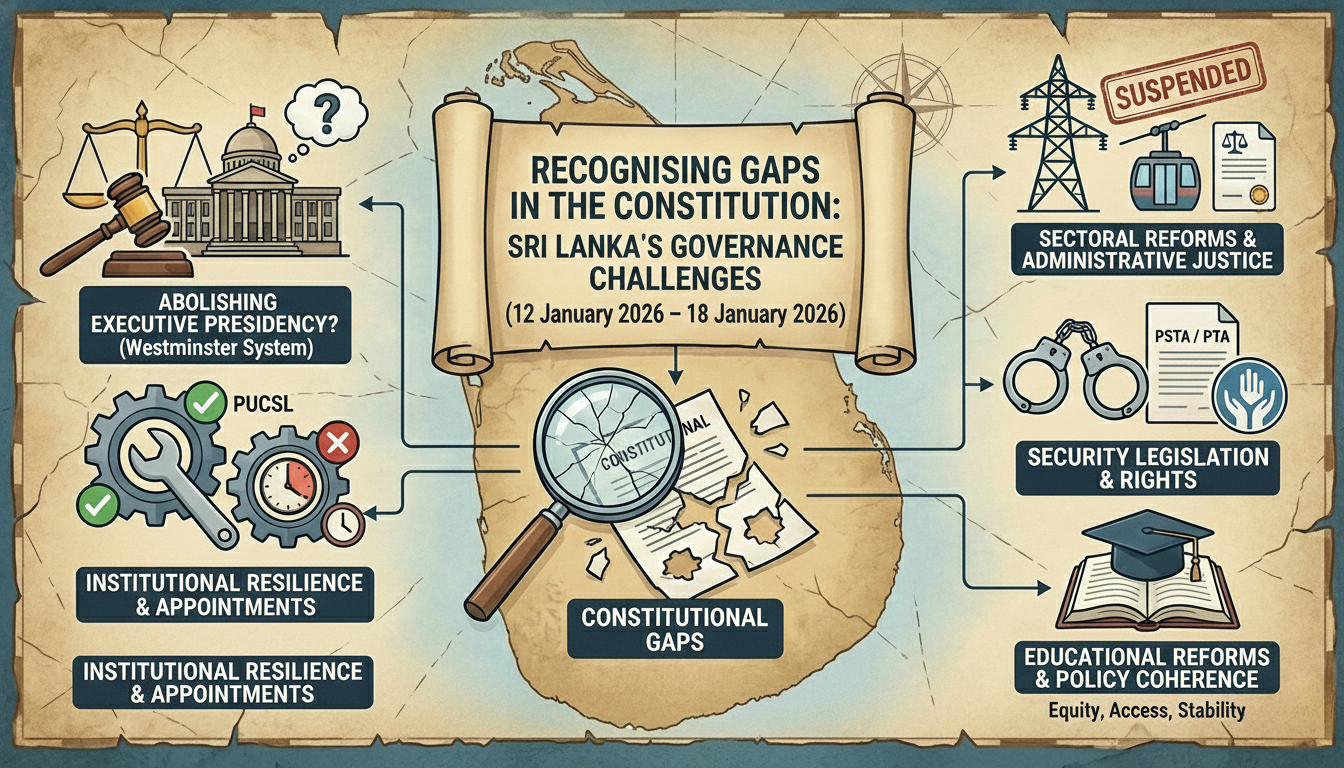
The media coverage of the third week of January attracted attention to the structural strengths and weaknesses of Sri Lanka’s constitutional order. It reflected significant constitutional aspects including limitations in the distribution of executive power, the resilience of independent institutions, administrative justice, and policy coherence. This article examines the key constitutional implications highlighted in the week’s media coverage.
Constitutional Structure
The Prime Minister stated that the Government intends to abolish the Executive Presidency and adopt a Westminster-style parliamentary system, with executive authority vested in a Prime Minister and Cabinet accountable to Parliament and a largely ceremonial Head of State. Given the constitutional nature of the reform, it was flagged that two thirds of the parliamentary majority and a referendum was needed for its establishment. The need for civil society engagement in the implementation of such reforms was also highlighted. This was further stressed by the Chief Minister of Tamil Nadu who stated that these reforms may marginalise Tamil political interests. In a constitutional aspect, this proposal would significantly change the basic structure of the constitution by altering how executive power works, how democratic oversight is maintained, and how minority groups are protected and represented. Therefore, in the pursuit of establishing such reforms it must be ensured that minority rights are protected and that the reform process is inclusive and participatory.
Independent Institutions and Appointments
This week’s media reports highlighted both the strengths and fragilities of independent institutions. While these bodies are essential for democratic accountability, several institutions continue to face serious limitations. The post of Auditor General remains occupied by an acting appointee after repeated rejections of nominees by the Constitutional Council. Delays were also observed in appointing new civil society members to the same council reflecting persistent institutional inefficiencies. In contrast, some institutions demonstrated resilience, the Public Utilities Commission of Sri Lanka (PUCSL) rejected a proposed electricity tariff increase, illustrating regulatory independence in action. At the same time, the proposed Microfinance and Money Lending Bill seeks to establish an independent regulator for microfinance institutions and moneylenders. These contrasting developments reflect that the effectiveness of independent institutions depends on timely appointments, transparent selection processes, and insulation from political interference.
Sectoral Reforms and Administrative Justice
This week entailed several sectoral reforms. Firstly, the Electricity sector restructuring under Act No. 36 of 2024 envisaged to unbundle the Ceylon Electricity Board and dissolve it with significant severance payments. Secondly, the suspension of the BOI-approved Ambuluwawa cable car project by the Central Environmental Authority raised concerns in relation to investor confidence, procedural fairness, and exposure to legal claims. Allegations relating to coal quality supplied to the Lakvijaya power plant also resurfaced. These matters raise questions on administrative justice, equality before the law, freedom to engage in lawful occupations, procurement transparency, and public finance accountability. They emphasise the constitutional significance on reasoned decision-making, adherence to natural justice, and effective judicial review in high-stakes regulatory and investment decisions.
Security Legislation
The Government reiterated plans to introduce the Protection of the State from Terrorism Act (PSTA) to replace or substantially revise the Prevention of Terrorism Act (PTA), citing concerns raised by international human rights mechanisms. This emphasises on narrower definitions, shorter detention periods, access to counsel, and enhanced judicial oversight, while critics argued that risks of overbreadth still remain. While security legislation directly engages with fundamental rights, including liberty, due process and freedom of expression, this debate highlights constitutional tension between national security objectives and rights protection, reinforcing the need for strict legal safeguards, proportionality and judicial supervision.
Educational Reforms and Policy Coherence
The government advanced wide-ranging education reforms including extended school hours, modular curricula, GPA-based assessments, restructuring of the Grade 5 scholarship examination, and vocational pathways from Grade10. These reforms will be implemented around systemic changes to curriculum, assessment, infrastructure, and public communication. Even though these reforms are not constitutional amendments, they engage principles of equality, non-discrimination, language accessibility, and the right to education. In such a context, they raise constitutional concerns regarding equitable access, safeguards against socio-economic stratification, and the need for transparency and stability in education policy implementation.
The Need for Constitutional Reforms
The developments reported during the third week of January does not merely reveal isolated policy debates, but deeper structural and constitutional vulnerabilities within Sri Lanka’s governance framework. These episodes reflect that constitutional resilience depends not only on formal amendments, but on inclusive processes, institutional integrity, administrative fairness, and consistent policy coherence.


Comments (0)
Sign in to leave a comment
No comments yet. Be the first to comment!