
Constitutional Reform and Governance Developments
(Review of Media Coverage: 19 January 2026 – 25 January 2026)
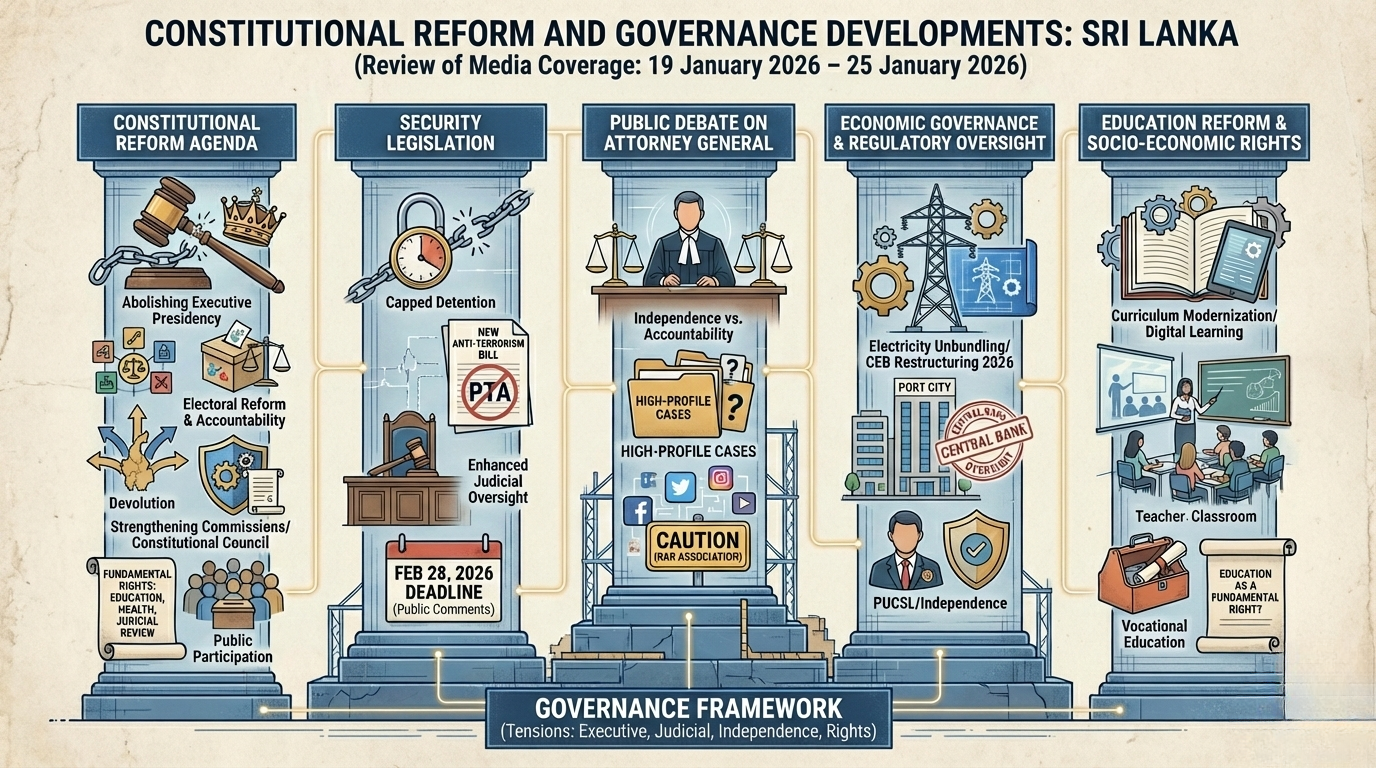
Media coverage during the fourth week of January foregrounded several structural and constitutional concerns within Sri Lanka’s governance framework. Reporting across multiple sectors, including constitutional reform, security legislation, prosecutorial independence, economic regulation, and education policy, revealed recurring tensions relating to executive power, judicial oversight, institutional independence, and the enforceability of fundamental and socio-economic rights.
Constitutional Reform Agenda
Public debate on a new constitution is centred mainly around six core reform pillars including the abolition of the Executive Presidency; reform of the electoral system through mixed-member proportional representation, campaign finance controls, and enhanced accountability of Members of Parliament; devolution beyond the Thirteenth Amendment; strengthening independent commissions through the Constitutional Council; expansion of fundamental rights to include education, health, and post-enactment judicial review; and structured public participation culminating in a national referendum. These developments engage with foundational constitutional questions relating to the separation of powers, democratic accountability, electoral representation, decentralisation of power, judicial review, and participatory constitution-making.
The proposed reforms signal a potential restructuring of Sri Lanka’s constitution. Curtailing or abolishing the Executive Presidency and strengthening independent commissions directly address long-standing concerns regarding the concentration of power and weakened checks and balances. The introduction of post-enactment judicial review would remedy structural gaps that previously insulated enacted legislation from constitutional scrutiny. Expansion of fundamental rights, particularly education and health, would impose enforceable obligations on the State, while renewed focus on devolution would reconcile minority political aspirations with concerns regarding the integrity of the unitary state.
Security Legislation
The Government has indicated its intention to replace the Prevention of Terrorism Act (PTA) with a new anti-terrorism framework, as a result of the sustained criticism from international human rights mechanisms and implications for trade preferences, including GSP+. Reported features of the proposed law include narrower definition of terrorism, capped detention periods, enhanced access to legal counsel, improved transparency, and strengthened judicial oversight. Consequently, the draft Protection of the State from Terrorism Bill (“the Bill”) was published on the Ministry of Justice website. Following its publication, the Ministry invited public comments within a duration of a month; however, the Ministry has extended the deadline for submissions until 28 February 2026.
Security legislation directly implies fundamental rights, including personal liberty, due process, freedom of expression, and protection against arbitrary detention. The proposed shift presents an opportunity to realign counter-terrorism powers with constitutional guarantees. Narrower definitions and limits on detention reduce the risk of overbroad application against journalists, activists, and protest movements. Enhanced judicial supervision aligns with broader constitutional debates on strengthening judicial review and safeguarding fundamental rights in security-related contexts.
Public Debate on the Attorney General
Public controversy has emerged around the role of the Attorney General, particularly concerning alleged reluctance to pursue certain high-profile prosecutions, decisions not to re-file specific cases, and reported internal disagreements. The Attorney General has asserted quasi-judicial independence and pointed to writ and fundamental rights applications as available remedies. The Government has stated that it respects the independence of the office and has taken no decision regarding removal, while acknowledging public concern over prosecutorial delays. The Bar Association has cautioned against decision-making influenced by public or social media pressure.
This issue engages constitutional principles relating to prosecutorial independence, accountability, separation of powers, and access to effective remedies. It highlights unresolved constitutional questions regarding the appointment, tenure, removal, and oversight of prosecutorial authorities. While independence is essential to shield prosecution from political interference, transparency, and reviewability are equally necessary to ensure equality before the law and public confidence in the justice system. Constitutional reform may provide clearer standards governing prosecutorial discretion and judicial review.
Economic Governance and Regulatory Oversight
The week’s media reports focused on major economic governance reforms that rely heavily on independent regulatory oversight. Under the Electricity Act No.36 of 2024, the power sector is scheduled for unbundling by 2026, with the Ceylon Electricity Board to be restructured into separate generation entities, an independent transmission operator, regional distributors, and a National System Operator. The framework emphasises competitive bidding, cost-reflective pricing, open access for large consumers, and an enhanced regulatory role for the Public Utilities Commission of Sri Lanka (PUCSL). Amendments to the Colombo Port City Economic Commission Act enacted in January 2026 strengthen oversight of offshore banking and tax concessions, vest regulatory authority in the Central Bank, and seek alignment with national financial stability objectives.
These reforms engage constitutional principles of regulatory independence, public finance accountability, due process in economic regulation, and the supremacy of national constitutional oversight. The success of these reforms depends on regulators insulated from political capture and empowered to act transparently. Aligning special economic zones with national regulatory institutions reinforces constitutional coherence and affirms that constitutional rights and oversight mechanisms apply uniformly, including within special regulatory regimes.
Education Reform and Socio-Economic Rights
A National dialogue is underway on comprehensive education reform, focusing on curriculum modernisation, teacher training, assessment reform beyond exam-centric models, digital learning integration, and expansion of vocational and technical education aligned with labour market needs.
Even though this may not be framed as a constitutional amendment, the reforms engage principles of equality, non-discrimination, access to education, and emerging debates on recognising education as a fundamental right. The reform agenda complements proposals to constitutionally recognise education as a justiciable right. Defining enforceable yet realistic State obligations focused on access, quality, and adaptability would strengthen policy coherence while avoiding purely aspirational guarantees.


Comments (0)
Sign in to leave a comment
No comments yet. Be the first to comment!