
Matters of the Constitution
Review of Media Coverage (23 February 2026 – 1 March 2026)
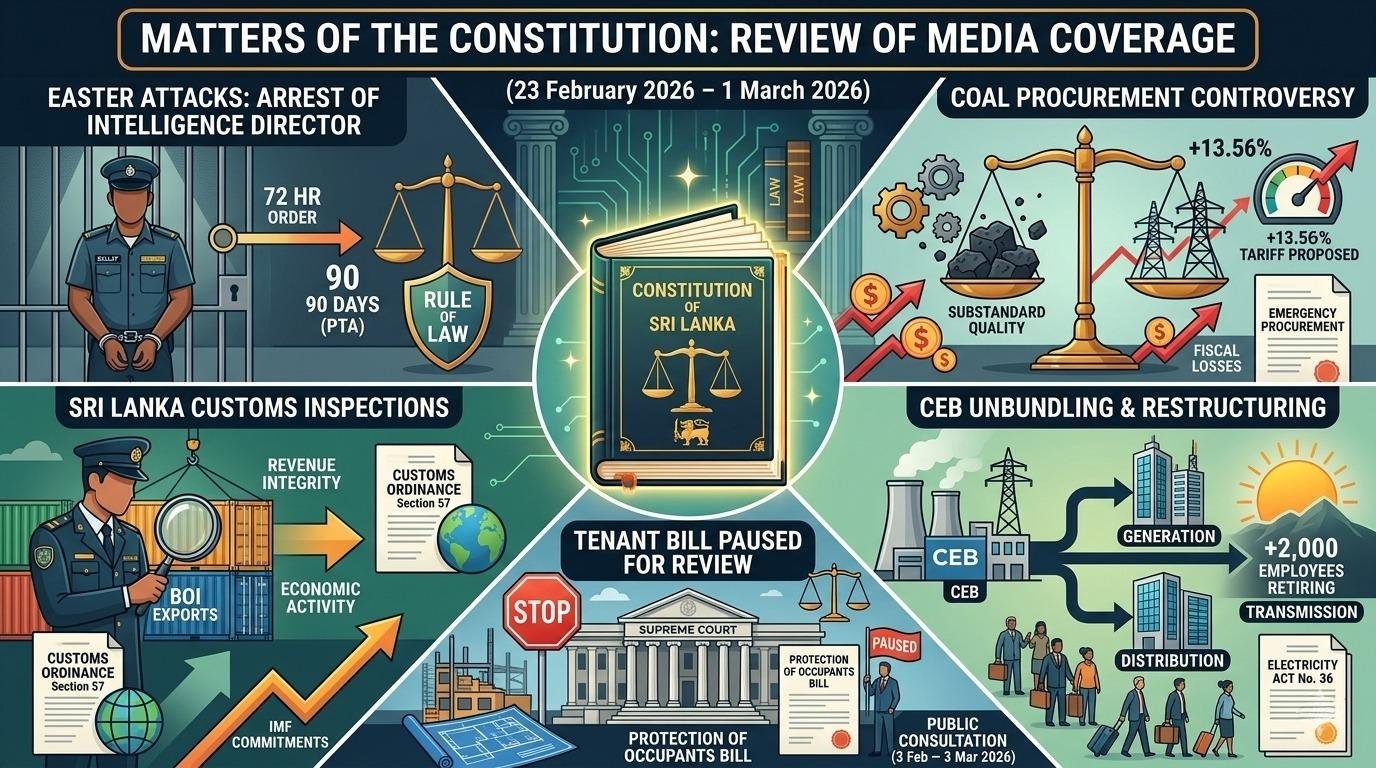
This week noted matters that raise significant constitutional questions relating to national security investigations, public procurement and fiscal accountability, economic regulation, trade and revenue administration, and legislative rights review. These issues reflect continuing debates concerning the scope of executive power, the accountability of public officials and state institutions, the integrity of regulatory and procurement frameworks, and the constitutional balance between economic reform, revenue enforcement, and protection of fundamental rights within a rule-of-law system.
Easter Attacks and Arrests
The former Director of the State Intelligence Service, Suresh Sallay, was arrested in relation to ongoing investigations concerning the 2019 Easter attacks and was initially detained under a 72-hour order, extendable up to 90 days under the Prevention of Terrorism Act (PTA).
Constitutionally, the arrest engages constitutional principles relating to national security powers, protection against arbitrary arrest and detention, equality before the law, and judicial supervision of executive detention. The detention of a former senior intelligence official reflects the constitutional commitment to accountability in matters of grave public concern. At the same time, reliance on extended pre-charge detention under the PTA highlights the need for strict judicial oversight and narrowly tailored application of extraordinary powers to ensure that the pursuit of justice remains consistent with rule of-law guarantees.
Coal Procurement Controversy and Tariff Implications
Significant discrepancies were reported in coal quality indicators, including calorific value, ash, and moisture content, alongside allegations of blending and identification of substantial fiscal losses through oversight processes. Cabinet approved emergency procurement of 300,000 MT of coal amid warnings of a potential mid-2026 power crisis. A 13.56% tariff increase for electricity supplies has been proposed, incorporating restructuring and voluntary retirement scheme costs, with the Public Utilities Commission inviting public comments.
This controversy engages with constitutional principles of public finance accountability, transparency in public procurement, and parliamentary oversight of executive expenditure. It emphasises on the constitutional necessity of integrity and transparency in procurement processes, especially when fiscal losses and consumer tariffs are directly affected. Emergency procurement decisions and proposed tariff adjustments must be grounded in lawful procedure, independent regulatory scrutiny, and public participation to preserve institutional legitimacy and public confidence in essential service governance.
BOI Export Inspections to Sri Lanka Customs
The Government has announced that, from July, inspection of BOI exports will be undertaken by Sri Lanka Customs pursuant to Section 57 of the Customs Ordinance, citing revenue integrity objectives aligned with IMF commitments.
This measure engages constitutional principles of legality, statutory clarity, and hierarchy of laws where overlapping regulatory mandates do not exist. This emphasises on the constitutional importance of balancing revenue enforcement with protection of lawful commerce. Its legitimacy depends upon clear conflict-of-laws rules, transparent operational guidelines, and independent oversight mechanisms to prevent arbitrary or discretion-driven interference with economic activity and to maintain investor confidence within a rule-of-law framework.
CEB Restructuring
The restructuring of the CEB under the Electricity Act No. 36 of 2004 is proceeding with the creation of separate state-owned entities for generation, transmission, and distribution, alongside a National System Operator. The regulatory role of the Public Utilities Commission is to be strengthened, while a voluntary retirement scheme has recorded significant uptake exceeding 2,000 employees.
Constitutionally, this engages principles of public enterprise governance, independent economic regulation, and parliamentary oversight of state-owned entities. It also implicates labour rights, equality and non-discrimination in public-sector reform, and administrative accountability in the reallocation of public assets and functions. The unbundling of a major public utility reflects a structural shift in the management of essential services and stresses on the constitutional importance of transparent governance, regulatory independence, and protection of worker and consumer interests. The legitimacy of such reform depends upon adherence to due process, fiscal accountability, and safeguards ensuring continuity, affordability, and equitable access to electricity as a critical public service.
Protection of Occupants Bill Paused
The Government paused the proposed Protection of Occupants Bill for reconsideration following concerns raised during Supreme Court review and public debate. This also followed a one-month public consultation period which started on 3 February 2026.
The proposed legislation engages constitutional protections relating to property rights, equality before the law, due process, access to courts, and proportional limitations on proprietary interests. The reconsideration of the Bill illustrates the role of judicial review and public participation in safeguarding rights compatibility prior to legislative enactment.



Comments (0)
Sign in to leave a comment
No comments yet. Be the first to comment!