
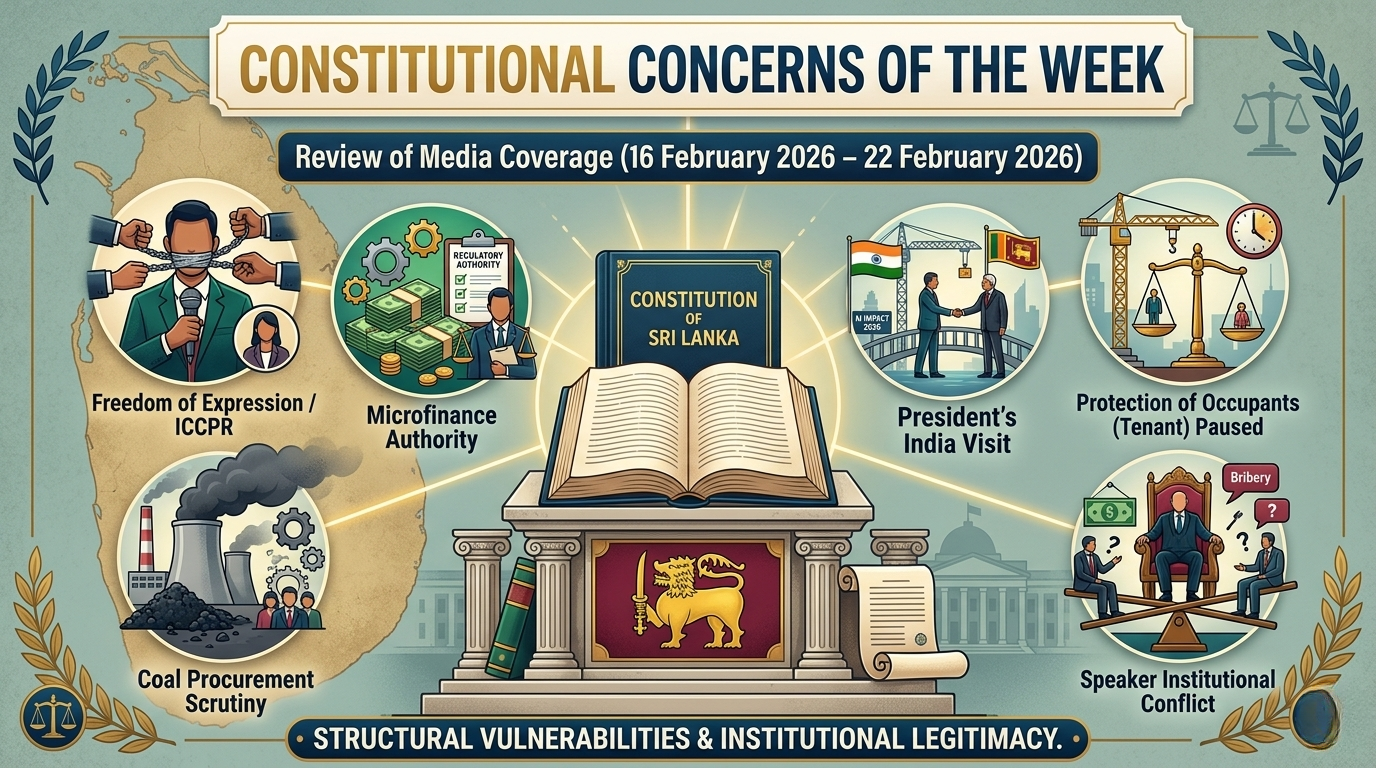
Constitutional Concerns of the Week
Review of Media Coverage (16 February 2026 – 22 February 2026)
This week’s media coverage reveals constitutional questions regarding freedom of expression and criminal law enforcement, financial regulation and consumer protection, property and tenancy reform, public procurement and fiscal accountability, foreign affairs and executive authority, and parliamentary ethics and institutional integrity.
The Case of Freedom of Expression
The Fundamental Rights case involving Natasha Edirisooriya, prosecuted under provisions linked to the International Covenant of Civil and Political Rights Act (ICCPR), re-entered public discussion following the proceedings before the Supreme Court of Sri Lanka. While a former CID official reportedly expressed regret before Court, and the Inspector General of Police indicated the guidelines would be issued concerning arrests under the ICCPR framework, Natasha still faces backlash from society.
From a constitutional aspect, the case engages freedom of expression, equality before the law, legality in criminal law, protection against arbitrary arrest and detention, and judicial oversight of executive action. It also raises questions concerning the permissible limits of speech regulation under international human rights standards incorporated into domestic law.
This situation sheds light on the constitutional necessity of narrowly defining criminal restrictions on speech, ensuring only advocacy of hatred amounting to incitement to discrimination, hostility, or violence is subject to sanction.
Establishment of Microfinance and Credit Regulatory Authority
The proposed Microfinance and Credit Regulatory Authority Bill seeks to address the oversight of microfinance institutions and moneylenders under a single licensing and supervisory framework. The Bill proposes registration requirements, interest-rate regulation, consumer-protection safeguards, and enforcement powers to address predatory lending practices and financial exploitation of low-income borrowers.
From a constitutional point of view this initiative engages constitutional principles relating to equality before the law, protection from exploitation, freedom of trade and occupation (subject to regulation), administrative fairness, and the role of independent regulatory bodies in economic governance.
The establishment of a unified regulatory authority highlights the constitutional importance of balancing economic freedom with social protection.
Protection of Occupants (Tenant) Legislation
The proposed Protection of Occupants (Tenant) Bill, intended to regulate recovery of possession and strengthen safeguards for tenants, was paused following concerns raised during Supreme Court review and public debate. In the meantime, the existing 2023 legal framework governing repossession of premises remains in force while reconsideration and consultation of the proposed bill continue.
The proposed legislation engages constitutional guarantees relating to the right to property, equality before the law, due process, access to courts, and proportional limitations on proprietary rights. This illustrates the constitutional necessity of balancing the rights of property owners with protections for vulnerable occupants.
Low-Quality Coal Procurement Controversy
Media reporting and parliamentary oversight discussions, including scrutiny by the Committee on Public Enterprises (COPE), raised concerns regarding the procurement of allegedly substandard coal for power generation. The controversy centres on potential financial losses, operational risks to electricity supply, and questions surrounding tender procedures and regulatory supervision.
Constitutionally, it engages with principles of public finance accountability, transparency in public procurement, separation of powers through parliamentary oversight, and the duty of the State to ensure reliable access to essential public utilities. The controversy reflects the constitutional importance of integrity in procurement processes, reasoned administrative decision-making, and effective legislative oversight of public expenditure.
President’s Official Visit to India
The President took part in an official visit to India, participating in the “AI Impact 2026” forum, engaging in high-level bilateral discussions focused on economic cooperation, technology partnerships, and regional collaboration.
The visit engages constitutional principles relating to executive power in foreign affairs, treaty-making authority, parliamentary oversight of international agreements, and the relationship between external economic commitments and domestic constitutional governance. Presidential engagement in international economic and technological cooperation highlights the constitutional allocation of foreign affairs powers and the necessity of transparency and accountability in entering bilateral or multilateral arrangements.
Speaker of Parliament and Institutional Conflict Concerns
Recent developments involving the Speaker of Parliament arose in the context of reciprocal complaints before the Bribery Commission and the suspension of Parliament’s Deputy Secretary General. Public discussion has centred on perceived conflicts of interest, particularly where the Speaker plays a role in constitutional or statutory appointment processes linked to oversight and anti-corruption institutions.
Constitutionally, this issue engages separation of powers, parliamentary privilege, independence of constitutional commissions, principles of natural justice (including nemo judex in causa sua), and the integrity of appointments mechanisms for oversight bodies. The controversy highlights structural vulnerabilities in constitutional design where individuals occupying high parliamentary office may simultaneously influence the appointment or functioning of bodies tasked with investigating public officials. Even the perception of conflict can undermine institutional legitimacy. The episode underscores the importance of transparent, multi-institutional appointment processes, safeguards against self-interest in oversight structures, and clear procedures ensuring accountability of parliamentary office-bearers while preserving legislative independence.



Comments (0)
Sign in to leave a comment
No comments yet. Be the first to comment!